Chapter 5: Giolitti's Second Ministry: Doing it "Right", 1903-1905
Key figures
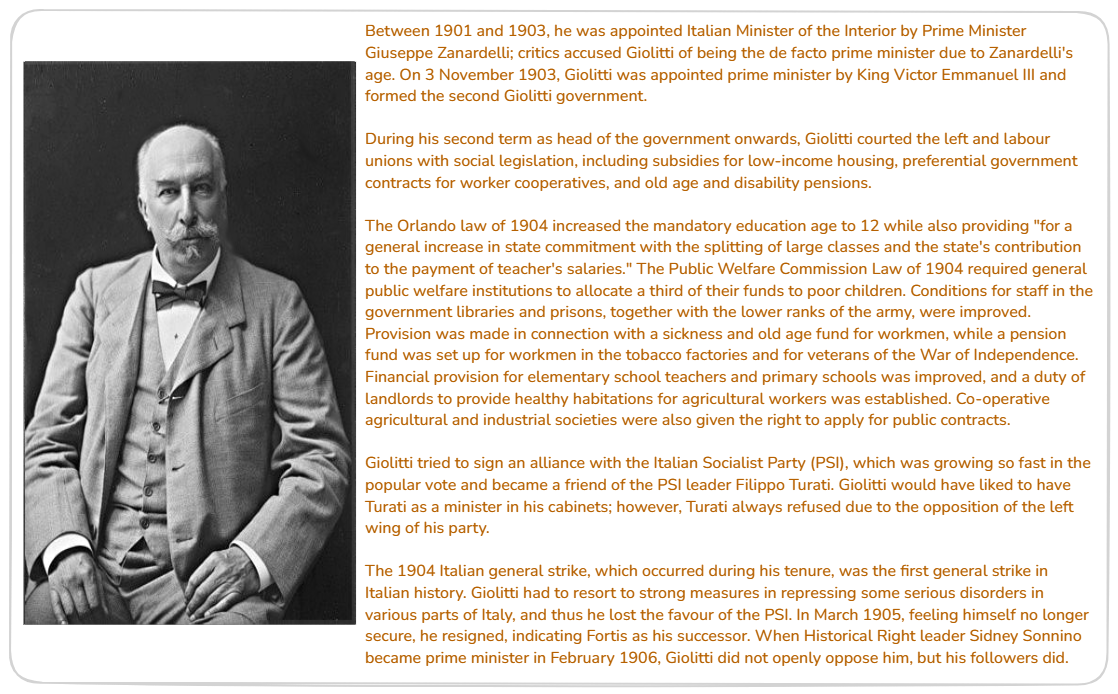
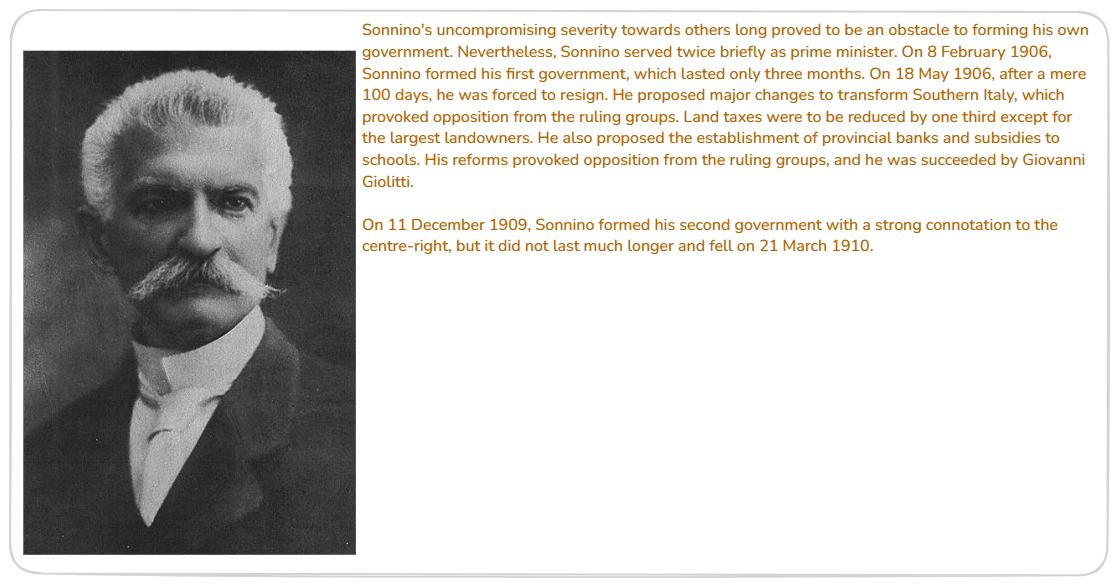
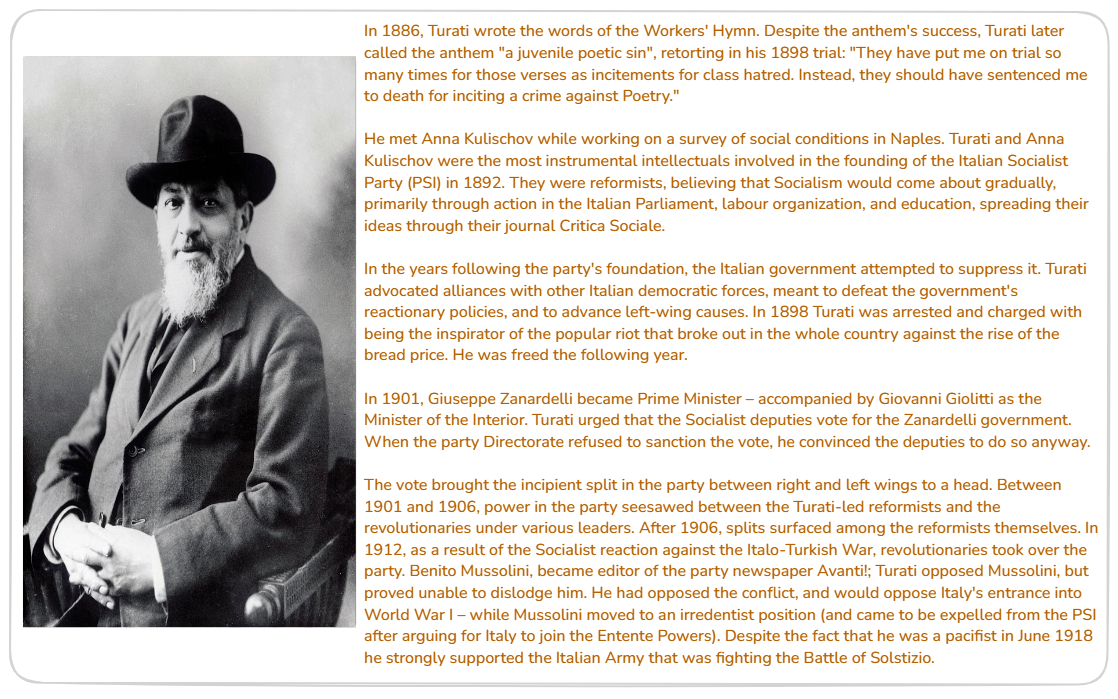
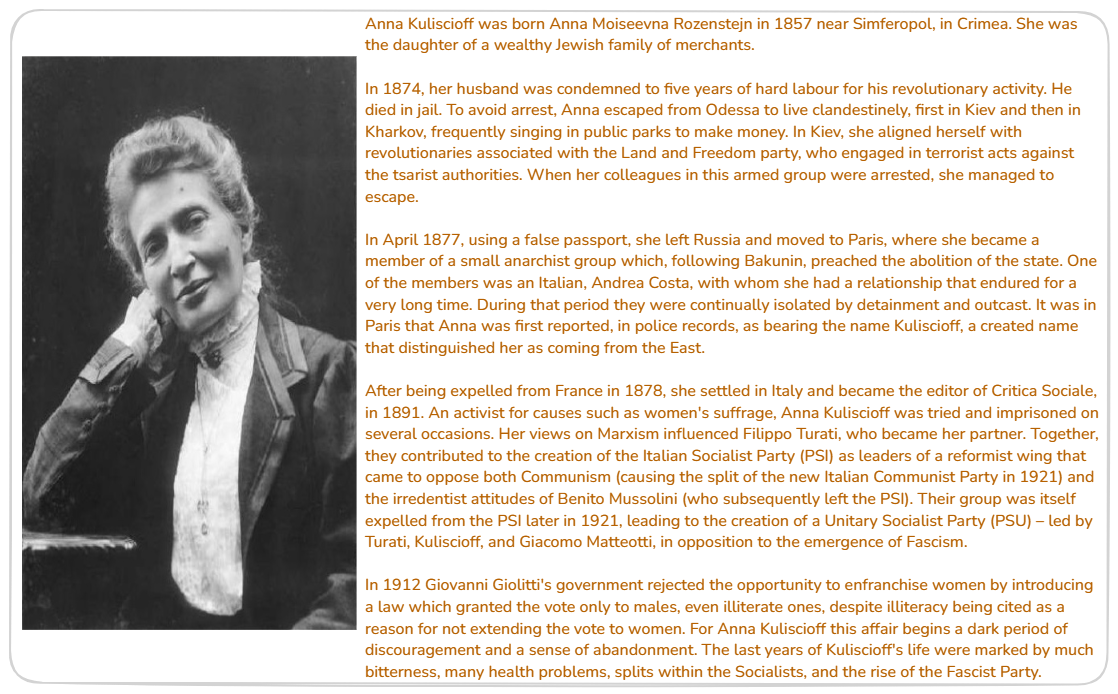
The waning days of the Zanardelli government were filled with maneuvers for the succession. Old and sick, Giuseppe Zanardelli saw that his last chance was to bring the Radical leader Giuseppe Marcora into his coalition, but the very tenuousness of the Brescian leader’s hold on power made Marcora hesitate.¹ Zanardelli’s followers, fearing the worst, approached Giolitti for some assurances that he would welcome them in the new majority and find a place for key leaders like Scipione Ronchetti and Francesco Cocco-Ortu in the government.² The possibility that Giolitti might even reach out to Sidney Sonnino met resistance from the left, but an extremely acute analysis by La Stampa anticipated the future development of both Sonnino and Giolitti. With surprising accuracy the paper predicted: “Sonnino is so little the head of a conservative party that in the hypothesis, today far off, of his return to power, he would call to take part in his government men of the Radical Party and we are not going to be far off the mark by saying that, if Filippo Turati wanted to take part in his government, he would be well received.” La Stampa also correctly anticipated that Giolitti would move to the right rather than to the left to find a basis for his government.³
Giolitti’s rise to power after 1901 has often appeared to be the inevitable consequence of the failure of repression a year earlier, but there was nothing inevitable about the 1903 government. He had previously failed as prime minister and might have been no more than a successful interior minister.Once again, as Giolitti formed his second ministry, he would be limited by the choices of the king, now a much friendlier Vittorio Emanuele III.⁴ The Estrema pressed him to form a pure left government, but this was not necessarily his inclination. Instead, he conducted simultaneous negotiations with Radicals, Socialists, and conservatives. Giolitti offered Filippo Turati a post in the government in the expectation that the Socialist would not be able to accept and, in the unlikely eventuality that he did, that the Socialist Party would split.⁵ On October 24, 1903, Giolitti told Carlo Romussi that he awaited a response from Marcora and anticipated a negative answer from Turati. He also reported to the king on October 29 Leonida Bissolati’s remark that participation in the government would split the Socialist Party: “I believe that Turati will not enter but the offer is useful to show that the monarchy does not exclude any reasonable progress.”⁶
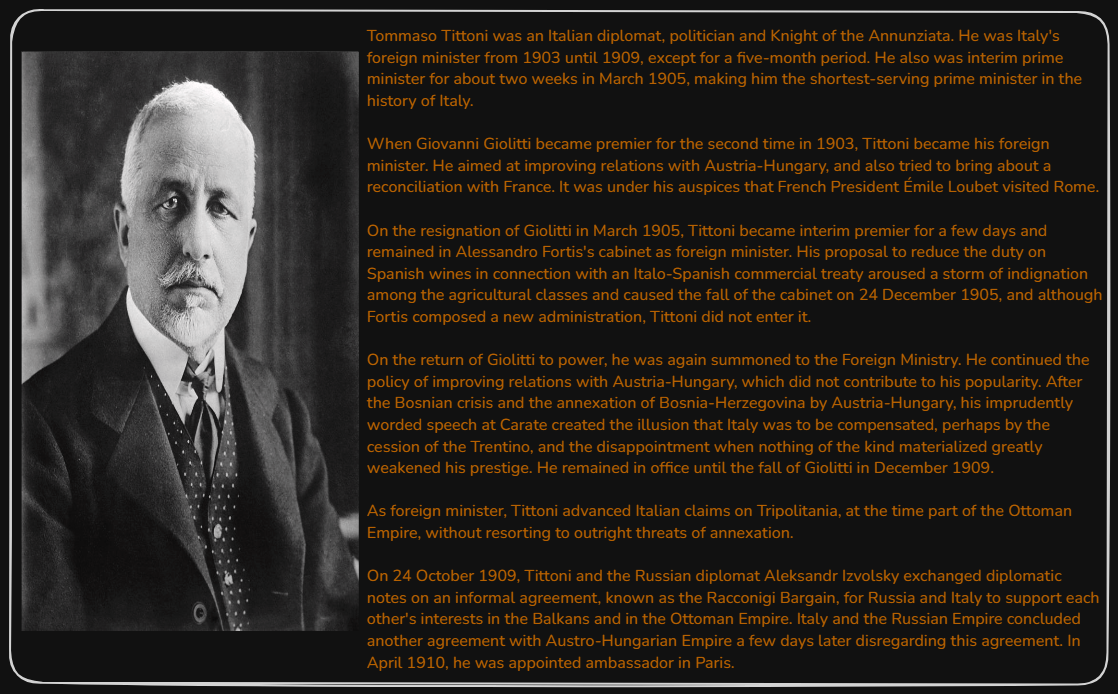
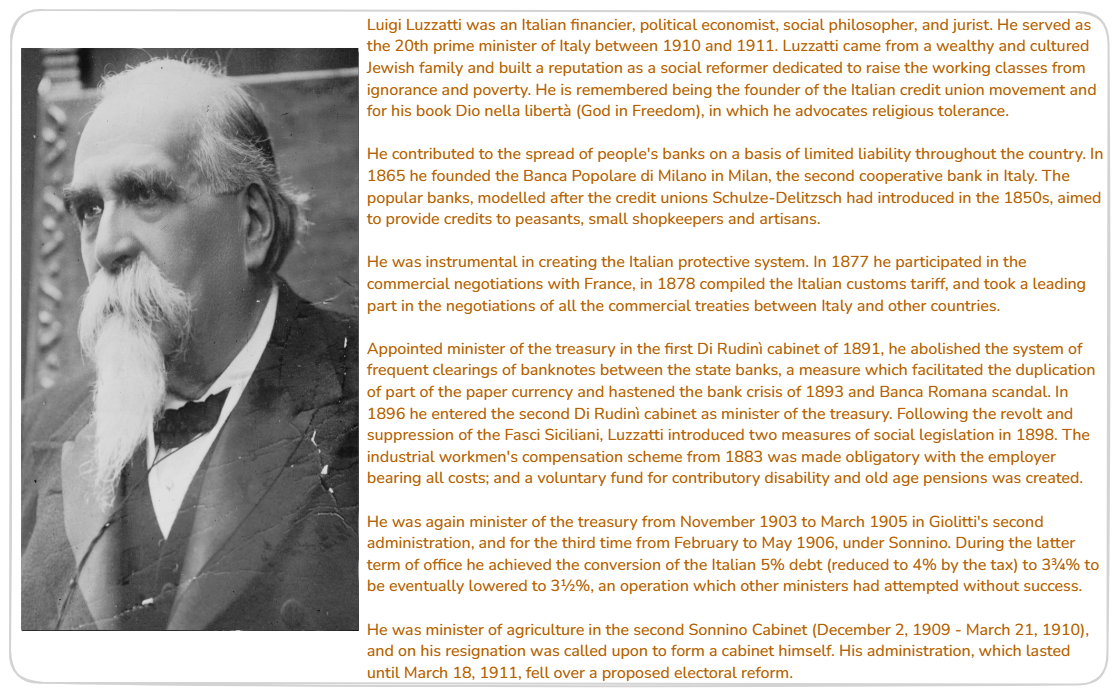
Giolitti’s discussions with the two rival Radical leaders, Marcora and Ettore Sacchi, were complicated by their earlier negotiations with Zanardelli. Marcora’s appetite had been whetted by Zanardelli’s offer of the interior ministry but could hardly aspire to it under Giolitti. Complicating the problem was a failed attempt by the Zanardellians to strike their own deal with Marcora to cut Giolitti out entirely.⁷ Giolitti’s negotiations with the Socialists and Radicals collapsed, but they went forward with the conservatives. The broad outlines of Giolitti’s strategy are unmistakable. He sought to build his base within the liberal center and right and in the South. Sensing Giolitti’s evolution, Romussi urged him to make apolitical appointments to the ministries of Foreign Affairs and Treasury. On October 26, Banca d’Italia director Bonaldo Stringher, a technocrat with ties to the left liberals, rejected Giolitti’s offer of the Treasury; the conservative Luigi Luzzatti accepted.⁸ The finance ministry went to Giolitti’s friend Pietro Rosano. Giolitti accepted the royal nominees for War and Navy but countered the pressure from the king to appoint the conservative Enrico Morin as foreign minister by naming the equally conservative prefect of Naples, Tommaso Tittoni, to that position. The Oxford-educated Tittoni, who was linked through his brother, Romolo, to the Catholic Banco di Roma and Vatican finance, had impressed Giolitti with his work in Naples.⁹
The balance within the ministry reflected Giolitti’s effort to build bridges to his liberal opponents. Francesco Tedesco, who passed to the majority from Pietro Lacava’s group, received Public Works. The tilt to the conservative side was somewhat balanced by the appointments of Rosano, Luigi Rava (Agriculture), and the Zanardellian Scipione Ronchetti (Justice). Giolitti bolstered his position in the center and the South with the nominations of Tedesco (from the Abruzzi), the Sicilian Prince Moncada di Paternò (who was forced to renounce but was followed by another Sicilian, Vittorio Emanuele Orlando), Rosano, and the undersecretaries Angelo Majorana (Sicily) and Girolamo Del Balzo (Abruzzo).¹⁰ The big losers were the Zanardellians, whose leaders—Augusto Ciuffelli, Francesco Cocco-Ortu, Roberto Talamo, and Nunzio Nasi, were excluded from the ministry.
The outcry on the left over the appointments of Tittoni and Luzzatti momentarily rattled Giolitti, who considered rejecting the mandate, but Senator Rattazzi reminded him that Sonnino or Antonio di Rudinì would then run the upcoming elections.¹¹ Rosano was another problem when he became the subject of a vicious press campaign over charges that he accepted a bribe to use his political influence to win the release of a Russian-born naturalized Italian, who had been sentenced to house arrest in Naples during the disorders of 1898. On November 9, the new finance minister committed suicide. A day later, a distraught Giolitti informed Victor Emmanuel that the government was in difficulty. La Stampa concluded that Rosano’s suicide presented more proof of Giolitti’s inadequacies, and Carlo Romussi warned him not to pick the successor from the moderates. However, the new prime minister again defied the left by naming Luzzatti ad interim.¹²
The cabinet appointments chilled Giolitti’s flirtation with the Socialists and Radicals. L’Avanti! was unremittingly hostile, and Il Secolo judged that Giolitti “could not choose a majority of ministers less worthy of governing the country.”¹³ Romussi’s words stung Giolitti, who shot back that Turati, Marcora, and Sacchi rejected his offers. Either he succeeded or conservatives would, “but be assured that the conservative party will run the elections.”¹⁴ Liberal reaction was more mixed. La Tribuna supported the government, but La Stampa was merciless. Rudinì wrote that Giolitti’s new government had “short legs” and would last “l’espace d’un matin.” “Sonnino, whom I have never liked, finds himself in a position a thousand times superior.” The good marchese was certainly no prophet.¹⁵
The Program of the New Giolitti Government
Giolitti presented his government with a minimalist program: new commercial treaties with Austria, Germany, and Switzerland; the conversion of the national debt; legislation on the future ownership of the railways; and increased aid for the South. He promised no great reforms, especially of the tax system, and studiously ignored foreign and military policy.¹⁶
Again the left was disappointed. For Antonio De Viti De Marco, a free-market Radical, the outcome of the crisis destroyed two illusions: that Giolitti was in the pocket of the Radicals and that the Radicals could profit from their alliance with Giolitti. Bissolati argued that Giolitti, no longer “the man of the future,” should have given up rather than ally with the right. Privately, Anna Kuliscioff lamented that with Giolitti’s speech went “the last hope of salvaging our, or better formerly our, man.” Nowhere was there “a trace, a remote hint, on tax reform.” Marcora, however, told Giolitti that it was his duty to continue, even without the participation of the Radicals and Socialists. In the voting, despite (or perhaps because of) the defection of much of the left, Giolitti’s bridges to the right and to some of Francesco Crispi’s followers held up. Rudinì voted in favor as did the crispini Camillo Finocchiaro-Aprile and Alessandro Fortis. Sonnino, the Socialists, most Radicals, and the Republicans voted against the government, which won handily, 284 to 117.¹⁷
The vote of December of 1903 marked a shift in the South in favor of the ministry. In the June 1901 debate on the new course in domestic policy, Southerners had voted 70–49 against Zanardelli and Giolitti. As late as March 15, 1902, on a confidence vote after a confrontation with railway workers, Southerners were still a large component of the opposition (43 to 55), but in December 1903 they gave the new government an 81–16 majority.¹⁸ Zanardelli made a well-publicized trip to Basilicata in 1902 that was followed by a special law for the region which received the support of the large grain producers. Naples was the recipient of no fewer than five special laws after 1902. When the new law for the industrial development of Naples was ready in March 1904, Giolitti cemented ties to the conservative establishment by choosing Francesco Girardi, an old-line political boss tied to the Camorra, to introduce the measure.¹⁹
One major piece of reform legislation emerged from the new government.Orlando put through an education bill that extended mandatory schooling from nine to twelve years with a common elementary course up to the fourth level, after which students would be tracked into the middle schools leading to the liceo and university or into schools that provided training but did not lead to higher education.²⁰ On other issues, such as the expansion of the franchise and rights for women, the Giolitti government remained extremely conservative. The Republican Roberto Mirabelli noted that only 7 percent of Italians were eligible to vote, whereas percentages were much higher elsewhere: France, 27.18 percent; Germany, 20.55 percent; England, 16.33 percent. When Mirabelli urged the vote for women, Giolitti intervened to call female suffrage a step away from the liberal state: “The only [party] that will be grateful to him [Mirabelli] and ought to erect a monument to him will be the clerical party.” Although the government accepted the right of women to practice law, it refused to alter the husband’s control over the person and property of married women or to grant the vote to literate women on the same terms as men.²¹
By rejecting a fairer and more progressive tax system and reduced military expenditures, Giolitti made the conservative Luzzatti the point man for the plan to refinance the interest rate on government bonds from 4 and 5 percent to 3 and 3.5 percent. The complicated operation took from 1903 to 1906 and saved the Italian Treasury 45 million lire annually. Coupled with the relatively favorable balance of trade (due in part to remittances from Italians abroad and tourism) and a remarkable 3.4 percent growth rate for the years from 1899 to 1907, Giolitti could pay for moderate reforms.²² Even with this windfall, little margin existed for a government hard pressed to spend more on the public works, postal, and interior budgets, coupled with the special laws for Naples and the South and the need to cover deficits in the railway system. When Luzzatti, stung by press attacks, halfheartedly threatened to resign, Giolitti refused even to consider it: ==“Your letter contains an anarchic principle because if the attacks of opposition newspapers could induce ministers to quit, government would no longer be possible and we ought to immediately think about making anarchism work.”==²³
If the conversion of the debt laid the groundwork for all the legislative initiatives of the government, the parallel renegotiation of the commercial treaties with Germany, Switzerland, and Austria strengthened the position of Italian exports to central Europe and promised some immediate relief to Southern agriculture.²⁴
The Nationalisation of the Railways
A major initiative, the state buyout of the railways, was an extremely complicated arrangement that was not concluded before Giolitti left office in 1905. The system was established in the mid-1880s. On April 24, 1884, conventions were signed that divided the system into three parts—two on the mainland and one for Sicily. The Adriatic lines were in the hands of the Società per le Strade Ferrate Meridionali, known as the Meridionali. The western side of the peninsula was given to the Società per le Strade Ferrate del Mediterraneo. The Società per le Strade Ferrate della Sicilia held the island routes. The conventions with the companies had been predicated on a period of economic expansion, but the 1880s and 1890s were years of agricultural depression and slow growth. By the turn of the century the lines needed further investments that the companies, nearing the term of the existing conventions, were unwilling to make.²⁵
The Italian parliament was deeply divided on the railway issue. Socialists took varying positions; Republicans were hostile to state control; the Radicals were divided between the free-marketers like De Viti De Marco and the spiritual heirs of Felice Cavallotti, who had favored state control. On the right, Luzzatti and Rudinì favored the state, but Sonnino switched sides on the issue. Zanardelli remained faithful to his earlier support for the private companies. Giolitti had served on the 1885 parliamentary committee that favored private control, but he also believed that important infrastructure investments should not be left in private hands.²⁶ Giolitti’s choice of Francesco Tedesco, an ex-inspector general of the railways, as minister of public works, and Luigi Luzzatti as treasury and finance minister indicated that he was moving to favor a state takeover.²⁷
State control was tied to the larger question of the status of the railway personnel. Luzzatti and Giolitti felt that the question of state management could be dealt with first, then the government could confront the unions with a new personnel code to define the status of the railway workers in matters of hiring, arbitration, wage increases, and a ban on strikes.²⁸ The unionization of state employees was a sore point in a country that had just barely accepted collective bargaining in the private sector. Luzzatti understood that the new industrial state would have to rethink its relations with the public sector employees and might use this occasion to press the concept of mandatory arbitration. The aim of the state, he felt, should be “to replace the civil war of the necessarily violent strike” with “the social peace of obligatory arbitration.” Luzzatti also expressed a deep suspicion of the reformist Socialists that probably echoed some of Giolitti’s fears: “It is best that the state does not let itself be always led by the warnings of reformist Socialists who in the last analysis are together with the revolutionaries.”²⁹
Pre-Electoral Maneuvers
Elections temporarily brought the negotiations with the companies to a halt. Giolitti was convinced that nothing more could be accomplished in the parliament that had been elected in 1900, but the government did not want to go to the country on the railroad issue: “It is possible that the ministry, by inviting the country to vote, confesses that it did not know what road to take.”³⁰ As luck would have it, the Socialists helped by calling a general strike, allowing Giolitti to frame the elections in terms of public order.
The railway question and the role of public service employee unions were linked to the government’s relations with the left after the failed cabinet negotiations of October 1903. After Giolitti’s militarization of the railway strikers in 1902, the limitations of his “new course” in domestic policy had become more apparent to labor.³¹ Giolitti built his majority by reinforcing the existing power configuration in the South and isolating its peasantry and by taking a hard line on issues of public order throughout the country. These stands inevitably led to confrontations with strikers but won him substantial conservative support by the time of the 1904 elections.³² Outside of the major cities, where public opinion played a role and the left was well organized, Giolitti maintained order with exceptional severity. In July 1904, during a strike at Pordenone in the province of Udine, he complained that those arrested received only four days in prison for insulting the army, whereas a worker in Milan was given thirty-five days for a minor insult to a Public Security agent:
Frankly, I would have understood if the opposite took place inasmuch as in Milan, a major [urban] area, a heavy or light sentence might pass unobserved, while in Pordenone everything is noted and commented upon. . . . The daily example of the guilty caught and punished, of reparations following damages, of expiations following crimes, the display of this exterior moral order, reconstituted and restored as soon as it is disturbed, must necessarily reinforce strongly the moral sense of the populations . . . drawing them to respect for law. (italics added)³³
Metternich could not have expressed it better!
Numerous criminal proceedings for impeding the right to work heightened the looming sense of confrontation in 1904. Excessive use of military force reappeared in incidents at Buggerru in Sardinia and at Castelluzzo in the province of Trapani.³⁴ Moreover, just as the government hardened its position, the Socialist Party passed from reformist to revolutionary control. The idea of the general strike spread throughout Europe after the successful use of this weapon in Belgium to expand the franchise. At the Socialist congress of Bologna in 1904, the revolutionary syndicalists who espoused the general strike tactic emerged as one of the strongest currents. In mid-September 1904 they gambled by calling a general strike, but they miscalculated badly. Giolitti called up two military classes and prepared decrees to militarize the railway workers, but then he held back to outwait the strikers. The movement collapsed within a few days. The strike, announced just after the birth of Umberto, the heir to the throne, proved to be a bonanza for Giolitti, who commandeered a special train in order to arrive at Monza for the registration of the birth. Moreover, the strike split the Estrema when the Radicals broke off cooperation with their Socialist allies.³⁵
The Decision for Elections
The elections of 1904, like those in 1909, 1913, and 1921, were organized to punish the Socialist Party and to form a broad anti-Socialist front of the bourgeoisie. This fact alone should dispel the myth of a Giolitti who harbored tender feelings toward Socialists of any stripe. The electoral campaign became a referendum on Giolitti’s handling of the general strike. Foreign policy and reductions in the military budget were barely mentioned. Instead, state management of the railways, improvements in primary and secondary education, and the allocation of some of the benefits from the debt conversion in favor of the poorest Italians were given pride of place.³⁶ Both Giolitti and Luzzatti wanted to avoid any discussion of the Triple Alliance, especially when tension with Austria revived after the closing of the Italian law faculty at the University of Innsbruck in November 1904. The incident risked becoming an excuse to increase military expenditures, thereby upsetting Luzzatti’s finely calibrated budget. The Treasury minister was also engaged in sensitive negotiations with the German Bleichroder Bank for debt conversion, which he felt would provide future means to defend Italy without “vain discussions about military expenditures.”³⁷ Giolitti left no doubt where he stood:
Therefore on our frontiers we have only allies and friends. Under these conditions would any sort of alarm that might induce us to modify our military program be justified? I do not believe so. . . . We have decided that the sums, presently deliberated by the Parliament, are sufficient for the aims that Italy proposes in its foreign policy.³⁸
When questioned by the Republican Roberto Mirabelli about a ban on public meetings after the Innsbruck affair, Giolitti defended the decision: “But the Honorable Mirabelli cannot forget that not everyone in Italy is educated in a way to be able to exercise the right of assembly under all circumstances, even the most serious and unpredictable, without bringing about harm to the same public liberties.” Either liberty would be controlled until the Italians had reached a certain level of political education or it would be lost. When Mirabelli complained that this response offered no guarantee against arbitrary rule, Giolitti cut him off: “I say that it is done de facto when the necessity of the state demands.” Mirabelli countered: “Fact is not law.” In what must be the essence of Giolitti’s basic beliefs, the president of the Council of Ministers fired back: “I said that there are no dogmas in political matters.” The irrepressible Mirabelli still had the last word: “But there are principles.”³⁹
If the military budget and foreign policy were off limits, so were issues of church-state relations. In France the government of the anticlerical Prime Minister Emile Combes was in the process of separating the church and state and had forged a majority on the basis of punishing the Catholic Church in the aftermath of the Dreyfus affair. Giolitti was determined to avoid anything similar in Italy, and the appointment of the clerical Tittoni was a guarantee in this sense to the Vatican. His orders to Justice Minister Scipione Ronchetti, an old anticlerical, were quite specific: “If you give speeches, it would be good if you did not raise the ecclesiastical question, which no one in the country cares about anymore.”⁴⁰
Socialist Bashing on the Campaign Trail
The 1904 elections revealed a clear government strategy to work for the triumph of the liberal bloc, even if it meant the victory of a conservative opponent of the government.⁴¹ As in 1892, Giolitti was intensely involved in the elections. Orders went out to the prefects in July 1904, well before the dissolution, to send him an estimate of the chances of the sitting deputy, possible opponents, and the forces behind each. ==If a Socialist or Republican victory was likely, every effort should be taken to get out the monarchist vote and to ensure that the polling places were watched over “by monarchists of secure faith.”==⁴²
The state apparatus, even the Bank of Italy, was mobilized behind the government’s candidates. When a superintendent of the archaeological excavations at Palestrina supported the subversives, Giolitti requested Public Instruction Minister Orlando to transfer him.⁴³ In the province of Udine, Giolitti called on Bonaldo Stringher, director of the Bank of Italy and former deputy from the college of Gemona in Udine, to hold the college for the liberals against a Socialist challenger.⁴⁴ Similarly, in Orvieto, where a Socialist challenged the government’s candidate, both Tittoni and Sonnino appealed for Stringher’s help to mobilize the government’s man. Just how the bank might intervene was made clear by the conditions, I fervently recommend to you [Stringher], as warmly as I can, to support the candidacy of Bracci, monarchist.⁴⁵ In the second round of voting of the branch at Grosseto again approached Stringher to request that the director of losing his seat to “one of the worst Socialists.”⁴⁶ The government also worked to form a solid bourgeois front in the rich agricultural provinces of Emilia, where the liberals, who held twenty-six of the thirty-nine Emilian seats in 1892, were reduced to only thirteen by 1900. The elections of 1904 marked a brief respite from the steady decline; they gained two seats in alliance with the clericals.⁴⁷
Luzzatti acted as a bridge to the conservative opposition, especially to inveterate opponents like Luigi Albertini of the Milanese Corriere della sera, whom Giolitti could never approach directly. In return, conservatives wanted Luzzatti to intervene with Giolitti in favor of Lodovico Gavazzi, the reactionary deputy from Lecco who had caused so much grief for the prime minister in 1893 over the Banca Romana and was in danger of losing the runoff election.⁴⁸ Occasionally, the government found itself up against a firm refusal by the conservatives to accept a democratic liberal, even if it meant a Socialist victory. In Venice, Tecchio, the editor of the democratic paper L’Adriatico,⁴⁹ In Padua, Giolitti ran into problems with Luzzatti when the government backed the radical Giulio Alessio. The Treasury minister was not inclined to back a Radical in his own political fiefdom and indicated that he would support conservatives in these cases, even against Giolitti.⁵⁰
The South presented a different order of problems. The Socialists were not strong, so it was often a matter of sorting out governmental support between two constitutional factions. In Castellammare, near Naples, however, the situation took on a more ideological coloration. The undersecretary at the Navy Ministry, Admiral Augusto Aubry, had a difficult time holding the college of Castellammare against a Republican. The inspector general of the Bank of Italy worked with the prefect of Naples and with the director of the local branch in favor of Aubry:
I interested him [the local director] in exerting his influence on our clients with prudence and discretion in favor of the governmental candidate. . . . I reserved for myself the more arduous task of catechizing the staff of the branch, who, though they are all monarchists, had with the exception of two or three adhered to the party opposed to Aubry.⁵¹
In Bari, Giolitti requested the help of the Bank of Italy to persuade an official of the bank to withdraw opposition to a government candidate.⁵²
To facilitate the passage of Southern conservatives to the governmental bloc in the South, ==Giolitti supported Francesco Spirito, a former ally of Crispi and Sonnino, against a candidate from the constitutional left.==⁵³ In a case made infamous by Gaetano Salvemini, Giolitti worked actively to promote the candidacy of Vito De Bellis in Gioia del Colle, in the province of Bari. De Bellis, an unscrupulous political operative who used any means to win, became Salvemini’s symbol of Giolittian corruption in the South:
Vito de Bellis is Giolittianism. If such a faithful Giolittian falls, the Giolittian band will no longer have the blind faith in the dictator from the Dronero as before. All Giolitti’s power rests in assuring his followers that only in him can they hope.
But, Salvemini wrote, Giolitti was also a prisoner of De Bellis. The majority was made up of many De Bellises.⁵⁴
The results of the election met Giolitti’s expectations. The Giolittians consolidated their strength in Piedmont with fifty of fifty-six deputies. In the South the 103 members of the governmental bloc were generally conservative. The Southern opposition amounted only to twenty-three deputies, of whom nineteen followed Antonio Salandra and Sonnino and four backed Rudinì. The extreme left hardly penetrated the South, where the constitutional forces won 126 of 137 seats. Overall, the Estrema lost twenty of its seats but Marcora’s five Radical followers were spared, as were the moderate Socialists Turati, Bissolati, Andrea Costa, and a few others. Luigi Roux complained that the government had also let most of the Sonnino-Salandra faction escape without serious opposition.⁵⁵ Moreover, Giolitti discreetly eased the way into the Chamber of Deputies for a number of clericals, most notably Carlo Ottavio Cornaggia Medici in Milan. In Rome the government and Catholics cooperated in the city’s 2nd college to elect the clerical conservative Felice Santini, against the Socialist leader Enrico Ferri.⁵⁶
Giolitti's resignation
At the opening of the new Parliament, Giolitti decided to replace Giuseppe Biancheri, the president of the Chamber of Deputies, who had been installed under Pelloux, with the Radical Giuseppe Marcora. Marcora might balance an overly conservative Chamber, and his election would complete the integration of one Radical faction into the majority. Rudinì, who had already heard rumors that Giolitti was thinking about leaving office—a good three months before he did so—wondered if Giolitti was trying to divide the majority into a clerical-conservative right and a liberal democratic wing in order to render the Chamber less governable for his successor.⁵⁷
An indication that Giolitti was not about to change direction on fundamentals came with his promotion, on Luzzatti’s suggestion, of the moderate Angelo Majorana from undersecretary to finance minister; Luzzatti stayed on at the Treasury. He also threatened to fire railway workers if they went on strike, leading Turati to lament the “governmental nihilism” that currently prevailed.⁵⁸ But “governmental nihilism” suited Giolitti quite well. Faced with a revival of agitation in rural Italy, he wrote to Justice Minister Ronchetti on January 2, 1905, that the reports of the prefects from practically all the provinces reflected a rise in disorders “to be attributed to the influence exercised over the ignorant and impulsive masses by persons who for one reason or another—animosity, private discontents or partisan spirit—are interested in exciting the low popular passions, fomenting agitations that end almost always in open rebellion.” The judicial arm should be all those who are guilty of instigation and incitement.” In brief, the “liberal” construction of the right to work, and conspiracy laws to prosecute crimes of opinion.⁵⁹
Giolitti was beginning to find his options limited. The rupture with the Socialists made him ever more dependent on the right and center of his coalition. The decision of the railway workers to carry the battle for full recognition of their rights to organize and to strike meant that Giolitti would have to use far more force than he wanted. By January 1905 the government opted for a state takeover of all the major lines in a single system to be directed by Leonardo Bianchi. At this point a confrontation with the workers was unavoidable. In February, Giolitti gave the go-ahead for a new personnel law with a strong anti-strike provision.The unions responded with a threat of obstructionism on the lines.⁶⁰ Simultaneously, Giolitti announced that he would resign for reasons of health. Just how sick Giolitti was, has remained a matter of speculation. Arturo Labriola, an unfriendly critic, argued that Giolitti planned to leave office immediately after the elections in order to avoid being pushed too far to the right by the conservative majority in the Chamber of Deputies. Rudinì’s letter, written in November, already spoke of a resignation, and lends credence to this version.⁶¹
On the other hand, Giolitti was really ill. He seemed to have a psychological and physical need for rest after a period of intense activity, and he had been at the center of events since 1901, punctuated by a brief illness in 1903. On February 8, Giolitti wrote to Luzzatti that he felt better but still had “hours of depression”: “What a rotten illness influenza is when it preys on the nervous system.”⁶² Mario Chiaraviglio described his father-in-law to Anna Kuliscioff as “much run down both physically and politically.”⁶³ The Giornale d’Italia, Sonnino’s newspaper, not noted for its tenderness to Giolitti, and the pro-government La Tribuna agreed that after a bout of influenza, Giolitti seemed to have been afflicted by nervous exhaustion, referred to as “neurasthenia.”⁶⁴
The Fortis interlude
In early February, ==Giolitti arranged a Fortis-Tittoni combination to succeed him.==⁶⁵ The choice of Tittoni, who was totally unacceptable to the left, indicated that Giolitti had no intention of mollifying the Radicals and the reformist Socialists, and that his government still had a majority in the Chamber of Deputies, so there was no need to turn power over to Sonnino. On March 4, Tittoni took the presidency of the Council of Ministers ad interim, while the former crispino and recent convert to Giolitti’s majority, Alessandro Fortis, tried to put together a government. The ambiguity of Giolitti’s alliances now became apparent. Because the majority had no guiding principles except loyalty to Giolitti, he had to intervene to pressure his supporters into backing Fortis. Only on April 4 was the new prime minister able to put together a coalition that reconfirmed the political balance of the earlier Giolitti combination: Tittoni at the Foreign Ministry, Majorana holding Finance, and the veteran Paolo Carcano at the Treasury in place of Luzzatti.
The vote of confidence revealed just how blurred the parliamentary lines between right and left had become. Most conservatives (64–25) followed Sonnino in voting against the government, but rudiniani Cesare Fani, Luzzatti, and Giulio Rubini all voted with Fortis and Rudinì abstained. The fifty-two Zanardellians split almost evenly. The bulk of Fortis’s support came from the ministerial center (forty-one) and the Constitutional Left (all but 6 of 151). Virtually the entire Estrema voted against the government. But the vote also revealed that Giolitti’s new course was now accepted by all sides as the framework for political action.⁶⁶
When Giolitti returned for the autumn parliamentary session in November 1905, the Fortis government was on its last legs. Urbano Rattazzi advised Giolitti in early November to break with Fortis over a commercial agreement with Spain that was very unpopular in Piedmont. He understood that Giolitti did not want to return immediately to office and suggested Sonnino, who would probably fail and open the way for Giolitti’s return.⁶⁷ Fortis resigned after losing a vote on the Spanish trade agreement on December 17. Though Sonnino was poised to assume office, the king requested that Fortis again form a government. This second Fortis ministry, with Antonino di San Giuliano as foreign minister, lasted barely a month. Senator Tommaso Senise jokingly asked Giolitti if “it was really true that you might be the architect of this not pretty work of art that is called the second Fortis government.”⁶⁸
The Opposition in Power: Sonnino's First Government
The Fortis government had been a continuation of Giolitti’s majority, just as the passage from Zanardelli to Giolitti in 1903 had been accomplished within the same majority. ==Now it was time for the opposition to be given a chance to govern.==⁶⁹ In 1904 and 1905, as he moved to the right, Giolitti had allowed too much political space to open up to his left. Except for Marcora’s group, the entire Estrema was in the opposition. Radicals who had flirted with power in November 1903 were now ready to support any government that would court them, as Sonnino left no doubt that he accepted the new course when he asked the Radicals to join his government.⁷⁰ But his alternative to Giolitti was as contradictory any Giolitti cabinet had been. Unable to break into Giolitti's centre-right to center-left bloc, Sonnino could govern only by uniting the intransigent conservative right with the estrema. Sonnino's alliance of anti-Giolliti conservatives and the Radicals might have revealed how uncomfortable he was at being pigeonholed on the right, but it certainly was not an example of a coherent majority. Yet, even assuming that this strange combination was possible, Sonnino was still short of a majority. The 221 votes against Fortis did not translate into an alternative majority without the votes of the Giolittians who backed him immediately.⁷¹ If Giolitti’s new course had truly led to a different framework for liberal politics, Sonnino should have represented the conservative opposition. In reality, Giolitti moved considerably to the right and Sonnino shifted leftward.
Sonnino’s conservatism contained sufficient radicalism to allow for negotiations with the Estrema. He could negotiate with the laissez-faire faction of the railways, and with the reformist Turati because he had always accepted universal suffrage.
From the perspective of the left, Sonnino was more principled than Giolitti on church-state issues. But, in the end, Sonnino could not put together a durable government that could accommodate the three main points of the left—universal suffrage, reduced military expenditures, and divorce—without losing substantial support on the right and center. Sonnino’s only hope was to win a dissolution of the Chamber of Deputies and run new elections, something Giolitti would never let him do.⁷²
The Sonnino government was wounded from the start. Giolitti forced Sonnino into an unstable left-right coalition that the Radical-reformist Il Tempo referred to as “a poorer copy of the Giolitti and Fortis governments.” Although its base was on the right with Francesco Guicciardini (foreign minister), Antonio Salandra (Finance), and Luigi Luzzatti (Treasury), it included the veteran Republican parliamentarian Edoardo Pantano (Agriculture) and Radicals Luigi Credaro (Public Instruction), Ettore Sacchi (Justice), and Giulio Alessio (undersecretary for finance). Sonnino then erred by not winning a confidence vote while he still had some momentum. Fortis resigned on February 2, and the Chamber of Deputies met for the first time under Sonnino on March 8. The result was that malcontents from all parts of the Chamber and Senate had time to organize.⁷³ Only one item, the proposal to limit the government’s power to dissolve local government councils, could be said to have been aimed at Giolitti. The rest of the program called for completing the railway takeover, aid for the South, and an end to the preventive censorship of newspapers. Since Luzzatti had taken a large part in the formulation of railway legislation under Giolitti, the Sonnino government could hardly claim a clean break with the past on this issue. An indication of Sonnino’s weakness came in the election to the various parliamentary committees. In seven of these large commissions (uffici) that examined all legislation, opposition candidates took the presidency and the Giolittians swept the elections for the budget committee. Sonnino’s legislative agenda was thus in the hands of his opponents.⁷⁴
Sonnino’s government offered more promise than results. The government proposed a law limiting the power of the central government to dissolve the communal and provincial councils. Such a law might have taken away one of Giolitti’s most useful electoral weapons, but after passing the Chamber of Deputies in March by a 160–118 vote, the bill stalled in the Senate and Giolitti withdrew it when he returned to power in May 1906. Sonnino also took a first step in bringing Southern primary schools up to national standards by introducing a bill for the state takeover of elementary education. He also proposed controls over the secret funds of the Interior Ministry, which Giolitti used to pay off journalists and to prepare for elections.⁷⁵
Sonnino’s government soon ran into trouble on its left flank. It had used the army to deal with labor agitation in Turin in April. To embarrass Sonnino, the Socialist leader Enrico Ferri called a general strike in Turin after a conflict between workers and police on May 6.⁷⁶ Simultaneously, the Chamber of Deputies debated a law, backed by the left, to establish a Labor Inspectorate to oversee workplace conditions. The bill was defeated on May 10 on a 103–110 vote after conservatives and free-market advocates combined against it. The same day the Socialists introduced a motion calling on the government to curb the use of force against workers. When the motion was rejected, the Socialist delegation resigned from the Chamber on May 11, 12, and 14, in what amounted to a public relations disaster for the government.⁷⁷
The passage of a large part of the Estrema into opposition encouraged the conservatives to attempt to form a homogeneous right government. Luzzatti had been unhappy for some time, and stayed on only to finish the railway and debt conversion projects.⁷⁸ Sonnino had settled with the Meridionale in a convention on March 26 and arrived at a settlement with the Mediterranea on April 13. This latter agreement finally brought the government down. Sonnino and Public Works Minister Pietro Carmine insisted that Parliament act immediately on the legislation. When the opposition asked for a delay, Sonnino lost a procedural fight over the legislative calendar and resigned.⁷⁹
Restive conservatives, discontented Zanardellians, and impatient Giolittians joined in voting against Sonnino. The long Fortis-Sonnino interlude revealed that the Giolittian bloc was far from a mere passive force. Many Giolittians defected first from Fortis, then from Sonnino, in order to force Giolitti’s hand.
Summary
October–November 1903: Formation of the Second Giolitti Ministry
Political Context
- Zanardelli's declining health triggered a struggle over succession.
- Giolitti's return to power was not inevitable; he had previously failed as Prime Minister.
- King Victor Emmanuel III proved more supportive than his predecessor.
Coalition Negotiations
Giolitti simultaneously negotiated with:
- Radicals
- Socialists
- Conservatives
Socialist Strategy
- Offered Filippo Turati a cabinet position.
- Expected refusal.
- Intended either:
- to expose Socialist unwillingness to cooperate, or
- split the Socialist Party if accepted.
Radical Negotiations
Negotiations with Radical leaders Giuseppe Marcora and Ettore Sacchi failed because:
- They had already negotiated with Zanardelli.
- Internal Radical rivalries complicated matters.
Conservative Success
After negotiations with the Left collapsed, Giolitti:
- Built support among liberals and conservatives.
- Strengthened his base in southern Italy.
- Shifted decisively toward the centre-right.
Composition of the Ministry
Political Balance
Appointments were designed to:
- Bridge divisions within Liberalism.
- Appeal to conservatives.
- Secure southern political elites.
Major Appointments
- Luigi Luzzatti – Treasury
- Tommaso Tittoni – Foreign Affairs
- Luigi Rava – Agriculture
- Scipione Ronchetti – Justice
- Francesco Tedesco – Public Works
Key Characteristics
- Conservatives gained important ministries.
- Southern politicians received disproportionate representation.
- Zanardelli's supporters were largely excluded.
Reactions
Left
Strong disappointment:
- Socialists denounced Giolitti.
- Radicals viewed the government as a betrayal.
- Newspapers criticised the conservative appointments.
Liberal Opinion
Mixed:
- La Tribuna supportive.
- La Stampa highly critical.
Government Programme (Late 1903)
Priorities
- Commercial treaties
- Debt conversion
- Railway legislation
- Financial aid for southern Italy
Notable Omissions
No commitment to:
- Tax reform
- Electoral reform
- Foreign policy reform
- Military reform
The programme deliberately avoided ambitious social legislation.
Parliamentary Victory (December 1903)
Confidence Vote
Government survived comfortably:
284–117
Political Importance
Support came from:
- Conservatives
- Centre Liberals
- Southern deputies
Opposition included:
- Socialists
- Most Radicals
- Republicans
- Sonnino
Southern Political Realignment (1903–1904)
Shift in Parliamentary Support
Southern deputies increasingly backed Giolitti.
Comparison:
- 1901 → opposed Zanardelli/Giolitti
- 1902 → still divided
- December 1903 → 81–16 majority for the government
Reasons
- Special legislation for Basilicata.
- Development funding for Naples.
- Patronage directed toward southern elites.
Domestic Reform
Education Reform
Giovanni Orlando introduced legislation:
- Compulsory education increased from 9 to 12 years.
- Unified elementary education.
- Early educational tracking introduced.
Electoral Reform
Little progress.
Government opposed:
- Universal male suffrage
- Women's suffrage
Only around 7% of Italians could vote.
Financial Reform
Debt Conversion
Luigi Luzzatti refinanced government debt:
- Reduced interest payments.
- Saved approximately 45 million lire annually.
- Provided resources for limited reform.
Giolitti rejected major tax redistribution.
Railway Nationalisation (1903–1905)
Background
Private railway companies:
- under-invested,
- expected state intervention,
- faced expiring concessions.
Political Divisions
Support and opposition cut across party lines.
Giolitti increasingly favoured:
- state ownership,
- public investment,
- central management.
Labour Question
Nationalisation required defining railway workers' status.
Government proposed:
- regulation of employment,
- compulsory arbitration,
- restrictions on strikes.
Luzzatti preferred:
- industrial peace,
- arbitration,
- stronger state authority over unions.
Pre-Election Politics (1904)
Election Strategy
Giolitti delayed elections until:
- railway issue postponed,
- public order became dominant issue.
The 1904 Socialist General Strike unexpectedly strengthened the government.
Public Order
Giolitti increasingly:
- suppressed strikes,
- prosecuted labour activists,
- used military force when necessary.
His policy shifted noticeably toward conservatism.
General Strike (September 1904)
Socialist Miscalculation
Revolutionary Socialists launched a national strike.
Giolitti:
- mobilised troops,
- prepared emergency powers,
- waited rather than immediately intervening.
Outcome
- Strike collapsed within days.
- Government emerged politically stronger.
- Radical-Socialist alliance fractured.
1904 Election Campaign
Central Themes
Campaign focused on:
- public order,
- anti-socialism,
- education,
- railway reform,
- debt conversion.
Foreign policy and military spending were largely avoided.
Government Intervention
State institutions actively supported government candidates.
Methods included:
- prefect supervision,
- Bank of Italy influence,
- pressure on local officials,
- electoral coordination against Socialists and Republicans.
Southern Strategy
Government prioritised:
- conservative constitutional candidates,
- patronage,
- elite alliances.
Socialists remained weak throughout most of southern Italy.
Election Results (1904)
Outcome
Government achieved a substantial victory.
Results
- Giolittians dominated Piedmont.
- Constitutional parties won almost all southern constituencies.
- Extreme Left lost approximately 20 seats.
Moderate Radicals and Socialists survived.
Giolitti's Resignation (1905)
Reasons
Combination of:
- genuine illness,
- political exhaustion,
- growing dependence upon conservatives,
- approaching conflict over railway workers.
Railway Crisis
Government prepared:
- complete railway nationalisation,
- anti-strike personnel legislation.
Conflict with railway unions became unavoidable.
Fortis Ministry (1905)
Transition
Giolitti arranged succession by:
- Alessandro Fortis
- Tommaso Tittoni
The ministry largely continued Giolitti's political coalition.
Characteristics
- No major ideological shift.
- Dependent upon Giolitti's influence.
- Parliamentary support remained unstable.
Sonnino's First Government (1906)
Formation
Sonnino attempted to unite:
- Conservatives
- Radicals
- Anti-Giolitti forces
The coalition lacked coherence.
Programme
Priorities included:
- completing railway nationalisation,
- aid to southern Italy,
- limiting executive interference in local government,
- reducing censorship.
Weaknesses
Government lacked:
- stable parliamentary majority,
- unified ideological base,
- control of parliamentary committees.
Collapse
Events leading to resignation:
- Labour unrest in Turin.
- Socialist walkout from Parliament.
- Disputes over railway legislation.
- Parliamentary defeats.
Sonnino resigned in May 1906.
Historical Significance
Giolitti's Political Strategy
- Built a broad centre-right liberal coalition.
- Marginalised the revolutionary Left.
- Relied heavily upon patronage and southern elites.
- Favoured pragmatic over ideological politics.
Major Achievements
- Stable parliamentary majority.
- Successful debt conversion.
- Foundations for railway nationalisation.
- Expansion of compulsory education.
- Consolidation of Liberal dominance before the extension of suffrage.
Major Limitations
- Abandoned meaningful tax reform.
- Rejected electoral democratisation.
- Opposed women's suffrage.
- Increasing reliance on conservative allies.
- Growing use of state power against organised labour.
Chapter 6: The Long Ministry, 1906 - 1909: The Heyday of the Giolittian System